


Hospital beds and stretchers move many times every day: from the ward to imaging, from the emergency room to admission, from the labour room to the operating room. Each move is a small physical task, and together they add up to one of the most demanding parts of clinical work. Safe patient handling programmes treat this load as a risk to manage, not as part of the job to accept.
This guide to safe patient handling is written by Intelligent Care (Incare), part of Stretchers Industries OOD, based in Sofia, Bulgaria. Incare designs motorized stretchers and beds, as well as patient isolation units, for healthcare providers across Europe and beyond. The explanations below are general; product data comes from the manufacturer.
What makes pushing beds and stretchers physically demanding?
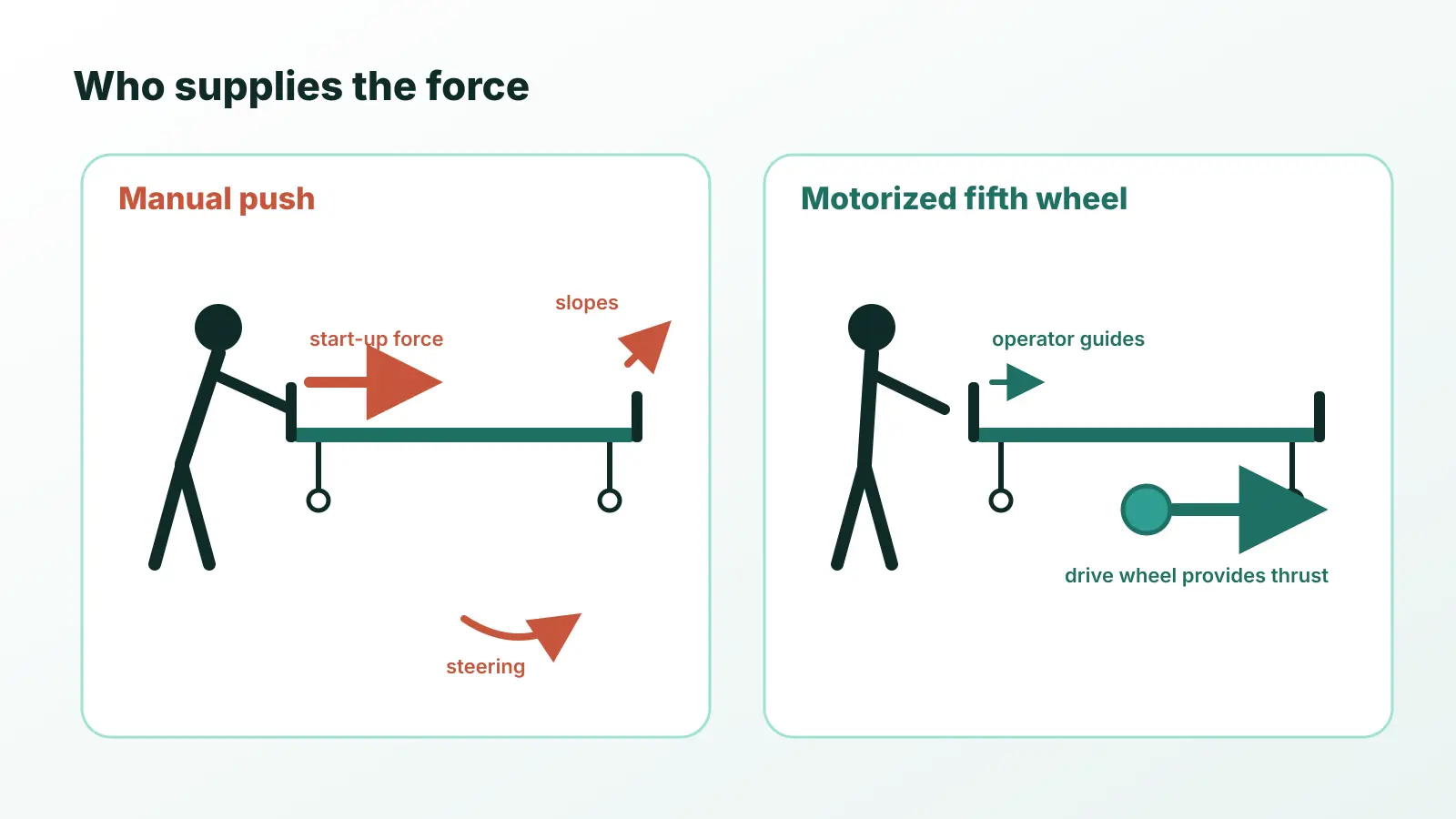
From a safe patient handling perspective, the heaviest part of pushing a bed is not the steady movement but the moments of change: starting from standstill, steering, climbing a slope, crossing a threshold or a cable, and stopping in a controlled way.
- Start-up force. Getting a loaded bed moving requires a peak effort much higher than keeping it rolling. The operator has to overcome inertia and the resistance of castors that are not yet aligned.
- Steering. Four swivelling castors make a bed easy to turn in place but hard to keep straight. In long corridors the operator constantly corrects the direction, often with a twisted posture.
- Slopes. Ramps between buildings and floors add the weight of the bed and patient to the push uphill and require holding back the load downhill.
- Thresholds, humps and cables. Lift doors, floor joints and cables lying across the path stop the castors abruptly, so the operator has to push harder or lift the end of the bed.
- Load. Bariatric patients, isolation canopies, oxygen cylinders and monitoring equipment all increase the total mass to be moved.
These efforts often happen in confined spaces, with a single person, and under time pressure in emergencies. A realistic safe patient handling plan starts by mapping where they occur in your facility.
Why is musculoskeletal risk a recognised occupational issue?
Work-related musculoskeletal disorders, which affect the back, neck, shoulders and upper limbs, are among the most common occupational health problems in Europe, and the healthcare sector is one of the sectors where manual handling of loads is a well-known cause.
The European Agency for Safety and Health at Work (EU-OSHA) identifies manual handling, pushing and pulling, awkward postures and repetitive movements as key risk factors for musculoskeletal disorders. Moving patients and the equipment that carries them combines all four, which is why safe patient handling is a priority in hospitals. Disorders often develop gradually, through repeated strain rather than a single accident, which is why they can be underestimated until a worker can no longer perform the task.
The usual approach in occupational safety follows a hierarchy: eliminate the risk where possible, reduce it with technical measures, then organise the work and train people. Power-assisted transport belongs to the technical measures of safe patient handling. It does not replace training or good practice, but it removes a large part of the force that the operator would otherwise provide with their own body.
Safe patient handling also protects patients. A bed that starts smoothly, keeps a straight line and stops under control means fewer jolts for a patient who is in pain, ventilated or in labour.
How does a motorized retractable fifth wheel work?
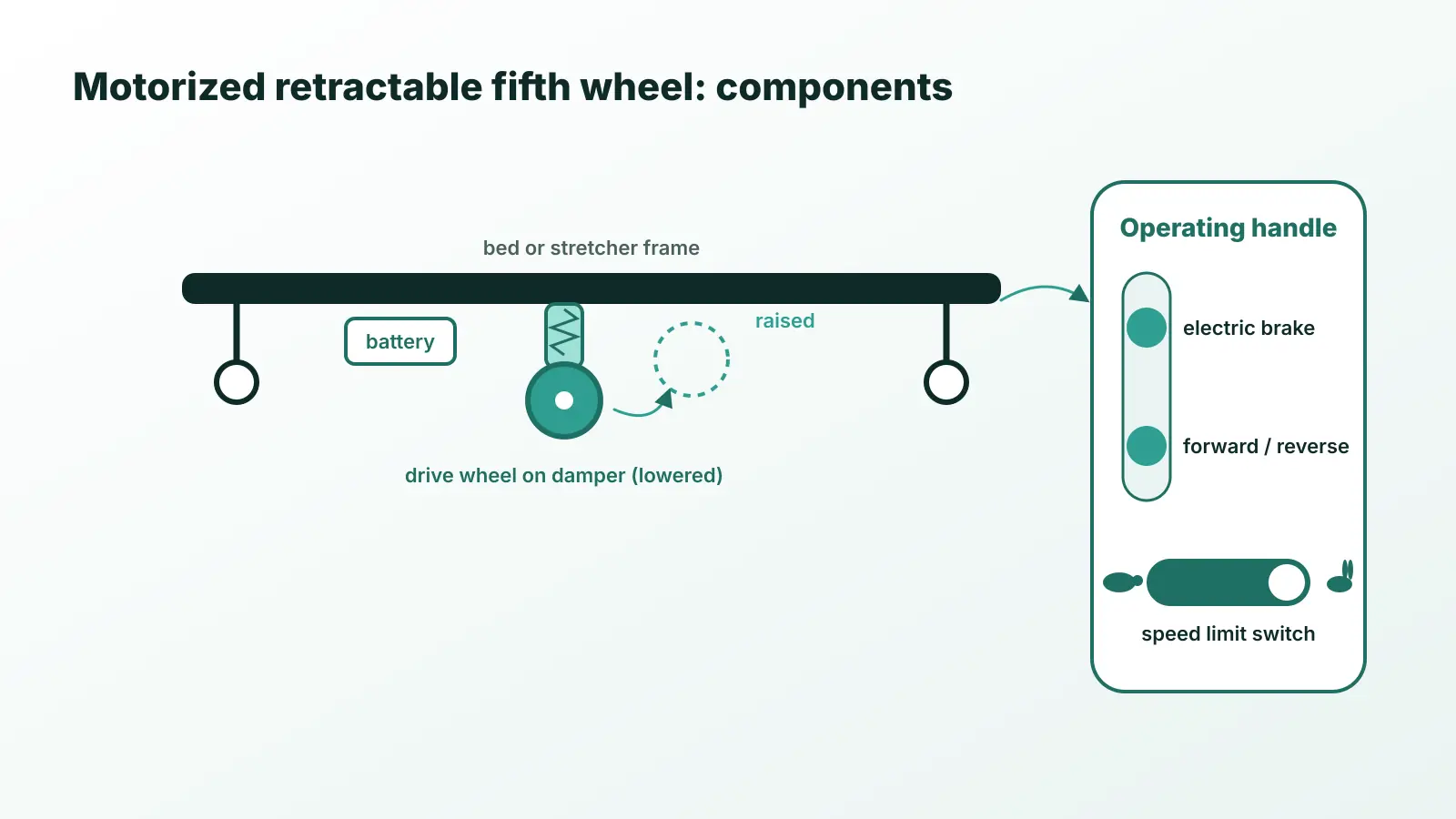
A motorized fifth wheel is an additional drive wheel mounted under the centre of the bed or stretcher; when lowered, it pushes and stabilises the bed, so the operator only guides it with the handles instead of supplying the force.
On Incare power-assisted equipment designed for safe patient handling, the system has four main elements:
- Motorized retractable fifth wheel. Installed on a damper device that keeps it in contact with the floor over uneven surfaces. It can be raised when not needed.
- Two operating handles. They integrate an electric brake and the change of direction, so the operator can move forward and backward and stop without letting go.
- Speed limit switch. Located on the handles, it offers two different maximum speeds. On the STR MK 10 the turtle sign limits speed to 2 km/h and the rabbit sign to 6 km/h.
- Battery power. The drive runs on a battery; the operating handle shows battery status and speed controls.
The central wheel also solves the steering problem. Because it is fixed in direction, it gives the bed a stable axis, much like a rear axle, so the bed tends to go straight in corridors and turns around the wheel when the operator steers. According to the manufacturer, the system reduces start-up push force and steering effort by up to 50% compared with manual pushing, and allows the bed to be manoeuvred with one hand, a direct gain for safe patient handling. On the STR MK 10 it is designed to transport patients of various sizes regardless of uneven surfaces or inclines.
Can one person move a bed or stretcher safely?
With power assistance, one trained operator can push and steer a loaded bed or stretcher through corridors, slopes and around obstacles such as humps and cables, which with manual equipment would often require two people.
Single-operator transport matters for safe patient handling for two reasons. Staff are a limited resource, and calling a second person for every move delays transfers. And where two people are needed, they rarely push with coordinated force, so one of them often ends up carrying most of the load in an awkward position.
A safe patient handling procedure for single-operator transport should still include a few rules:
- Use the slow speed setting in crowded areas, lifts and near doors; use the faster one only on clear, straight routes.
- Lower the fifth wheel before starting and raise it when the bed is parked, so the castors can be locked.
- Keep both hands on the handles on slopes and use the electric brake rather than holding the bed back by force.
- Ask for a second person whenever the clinical condition of the patient requires it, regardless of the equipment.
In emergencies the gain is clear. The Lotus delivery bed, for example, is equipped with a motorized fifth wheel for quick emergency transport from the labour room to the operating room, without moving the patient to another bed.
How to choose equipment for safe patient handling
Start from the routes and the patients, not from the catalogue: map where beds and stretchers travel, how heavy the typical load is and who moves it, then choose the device that matches each situation.
Questions to ask
- Which routes are longest or steepest? Ramps, connections between buildings and lifts with thresholds benefit most from power assistance.
- What is the load? Bariatric patients need a bed designed for higher capacities. Isolation canopies and medical equipment add mass.
- How often is a second person called? Frequent two-person moves are a sign that single-operator assistance would help.
- Is the bed also a care surface? A delivery bed or a bariatric bed that is also transported avoids transferring the patient from bed to stretcher, which is itself a handling task.
- Infection risk? When the patient must stay isolated, choose a motorized isolation stretcher or bed; see our guide to infectious patient transport inside the hospital.
- Configuration. Size, accessories and controls can often be customised; Moovie, for example, is highly configurable in size and accessories.
Comparing Incare power-assisted equipment for safe patient handling
| Product | Type | Power-assisted transport | Key data from the manufacturer |
|---|---|---|---|
| Moovie | Motorized emergency stretcher | Standard: retractable fifth wheel, two handles, speed limit switch | 214 x 74 cm, height 58 to 90 cm, safe working capacity 250 kg |
| Lotus | Motorized delivery and obstetric surgery bed | Retractable fifth wheel, two handles, speed limit switch | Electrically operated, configuration changed in seconds |
| STR MK 10 | Bariatric care hospital bed | Retractable fifth wheel, turtle 2 km/h and rabbit 6 km/h | 4 LINAK motors, rechargeable backup battery |
| STR MK 5 | Emergency stretcher with isolation system | Motorized version of STR MK 4, two maximum speeds | U15 filtration, negative and positive pressure |
| STR MK 8 | Hospital bed with isolation system | Motorized version of STR MK7, fifth wheel on damper | U15 filtration, negative and positive pressure |
Training and maintenance complete a safe patient handling programme. Operators should practise speed settings, braking and retracting the wheel before using the device with patients, and batteries should be charged as part of the daily routine.
Incare power-assisted beds and stretchers for safe patient handling
To support safe patient handling across departments, Incare applies the same power-assisted transport system to an emergency stretcher, a delivery bed, a bariatric bed and two isolation devices, so the operator finds the same handles and controls across departments.
Moovie: motorized emergency stretcher
Moovie is a 2-section hydraulic stretcher with adjustable height on a steel frame with four swivelling antistatic castors of 20 cm and a motorized wheel of 17 cm. Height, mattress platform, Trendelenburg and reverse Trendelenburg are controlled by side foot pedals, the backrest by a servo-assisted gas spring, and the siderails fold down completely for zero-gap transfers. The base includes space for an oxygen tank of up to 7 liters.
Lotus: motorized delivery bed
Lotus is a delivery and obstetric surgery bed for the various stages of care during pregnancy, labour and delivery. It is electrically operated, its configuration changes in seconds, and the patient in labour no longer needs to be moved to another bed.
STR MK 10: bariatric hospital bed
The STR MK 10 bariatric bed uses 4 LINAK motors for electrical height, backrest and legrest adjustment, Trendelenburg, Fowler and vascular positions and an auto-contour function. It has CPR handles and button, cross locking castors and a rechargeable backup battery, plus the turtle and rabbit speed settings on the fifth wheel handles.
STR MK 5 and STR MK 8: isolation with power assistance
The STR MK 5 is the motorized version of the STR MK 4 emergency stretcher with isolation system, and the STR MK 8 is the motorized version of the STR MK7 biocontainment bed. They bring safe patient handling to transfers where the patient must remain isolated and the device is heavier than a standard stretcher.
See the whole power-assisted range for details.
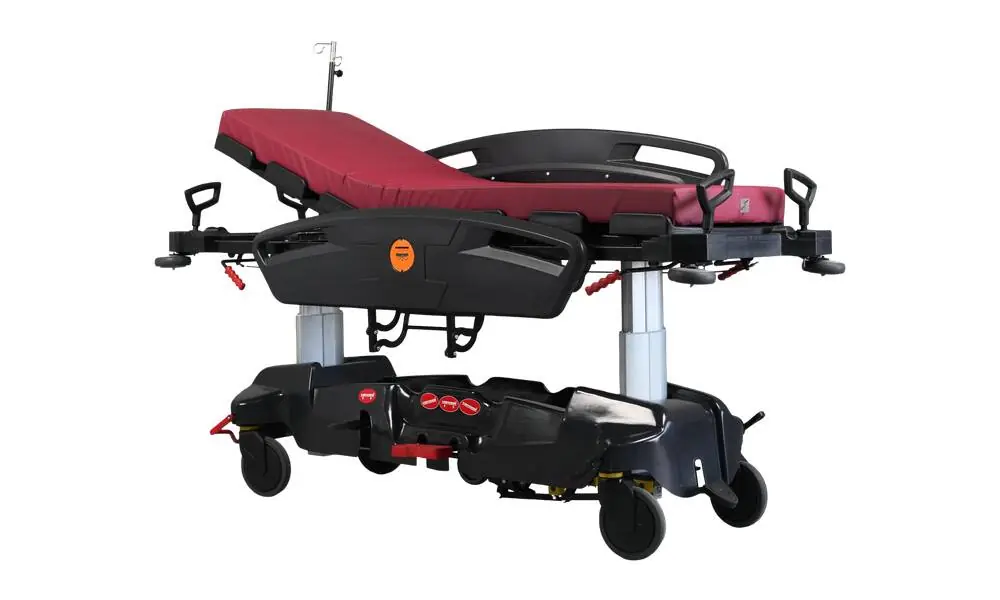 MoovieMotorized emergency stretcher, 250 kg capacity.View product
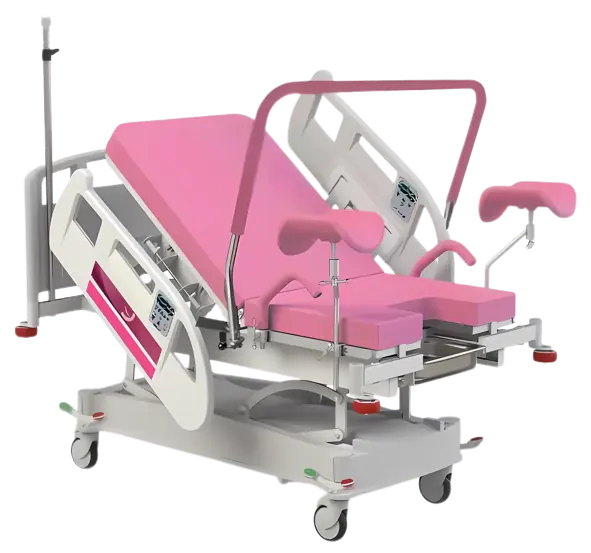 LotusMotorized delivery and obstetric surgery bed.View product
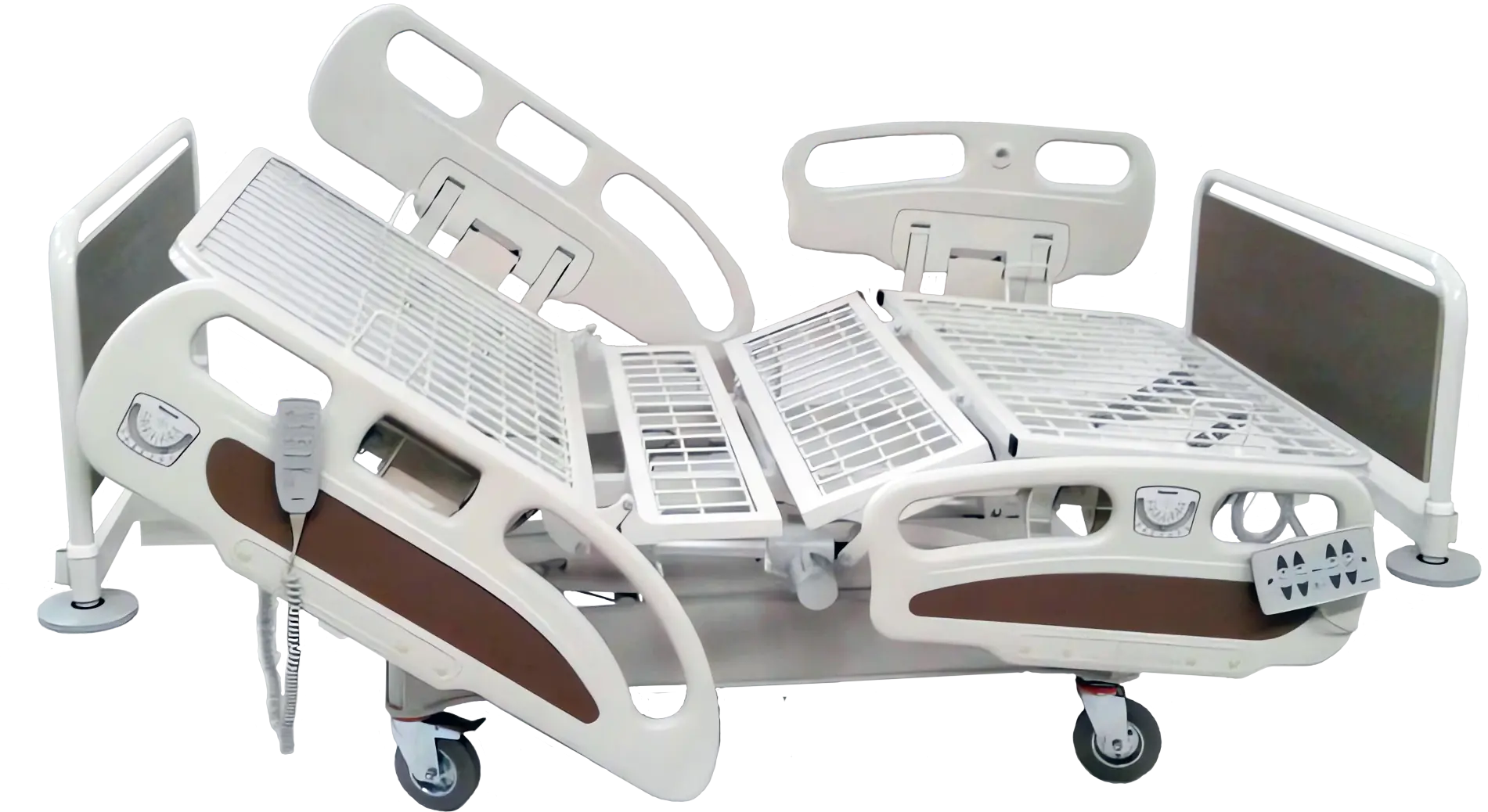 STR MK 10Bariatric care bed with 4 motors and fifth wheel.View product
A different kind of mobility. The Incare Handbike is not a patient transport device. It is an electric unit that attaches to wheelchairs with a fixed front frame, so that the wheelchair user can travel independently.
Frequently asked questions about safe patient handling
What is safe patient handling?
Safe patient handling is the set of equipment, procedures and training that allows healthcare workers to move, transfer and transport patients while limiting the physical load on their bodies and the risk of injury to both staff and patients.
How much effort does a motorized fifth wheel save?
For its power-assisted beds and stretchers, Incare states that the motorized retractable fifth wheel reduces start-up push force and steering effort by up to 50%, allowing the operator to manoeuvre with one hand.
What do the turtle and rabbit settings mean?
They are the two positions of the speed limit switch on the handles of the STR MK 10. The turtle sign limits the maximum speed to 2 km/h for slow, precise movements, and the rabbit sign allows a maximum of 6 km/h for longer straight routes.
Is the fifth wheel always in contact with the floor?
No. It is retractable, so it can be lowered for power-assisted transport and raised when the bed or stretcher is used in a fixed position or moved manually on its castors.
Which Incare products have power-assisted transport?
Moovie, Lotus and STR MK 10 in the power-assisted line, plus the STR MK 5 and STR MK 8, which are the motorized versions of the STR MK 4 emergency stretcher and STR MK7 isolation bed.
Is the Handbike a patient transport device?
No. The Handbike is a separate mobility product: an electric unit that attaches to a wheelchair with a fixed front frame and lets the wheelchair user travel independently.
Reduce the effort of every transfer
Tell us which routes and patients challenge your team, and we will help you choose power-assisted beds and stretchers for safe patient handling in each department.