


Pressure-controlled isolation is one of the most effective engineering measures a hospital can use against infections that travel through the air. Intelligent Care is part of Stretchers Industries OOD, based in Sofia, Bulgaria, and designs isolation units for transport, care and rooms for healthcare providers across Europe and beyond.
This guide sets out the principles behind negative pressure isolation and its positive pressure counterpart: the clinical situations each mode is meant for, the physics that makes it work, the difference between room-scale and portable systems, and the practical questions hospitals face when they plan isolation capacity. The final section shows how the same principles are built into the Incare range of stretchers, beds, chairs, rooms and antechambers.
What is negative pressure isolation?
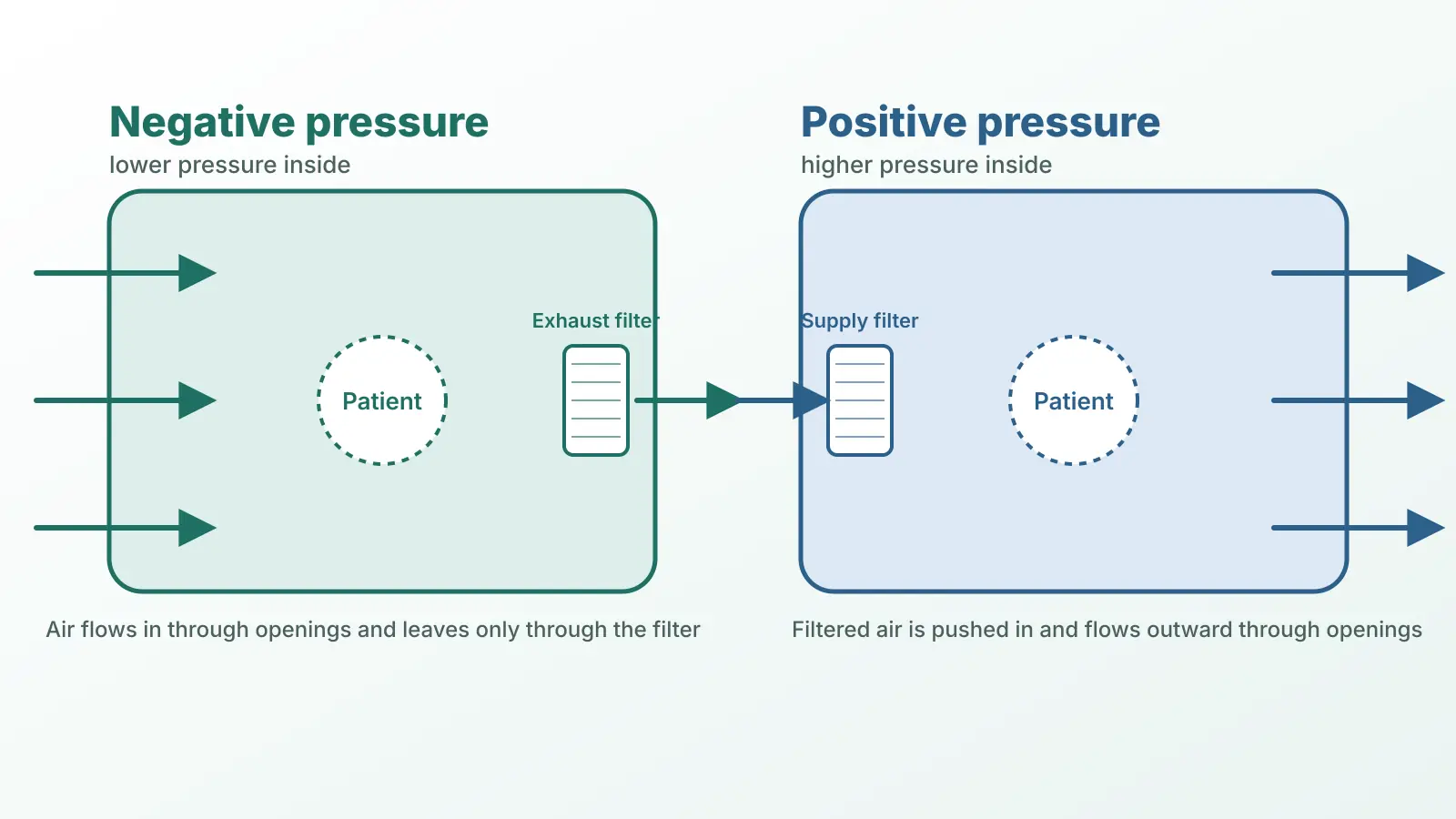
Negative pressure isolation is a containment method in which the air pressure inside an isolation space is kept lower than the pressure around it, so that air always flows inward and contaminated air can only leave through a filter.
Air moves from higher to lower pressure. When a fan continuously extracts air from an enclosure and discharges it through a filtration stage, the pressure inside stays below that of the corridor or ward outside. Any gap, seam or opening then becomes an inlet rather than an outlet. The patient can breathe, cough and receive care inside the space while the aerosols they generate are drawn towards the filtered exhaust, not towards the staff standing nearby.
The beneficiary of negative pressure isolation is therefore everyone outside the enclosure: other patients, healthcare workers, visitors and the wider facility. Negative pressure isolation is a form of source control, meaning that the infectious material is contained where it is produced.
What is positive pressure isolation?
Positive pressure isolation reverses the logic of negative pressure isolation. Filtered air is pushed into the space so that the pressure inside is higher than outside, and air escapes outward through any opening. Dust, bacteria, spores and viruses present in the surrounding air are opposed by that outward flow and cannot easily reach the patient. Here the person being protected is the one inside.
Both approaches use the same physical elements: a sealed or semi-sealed boundary, a blower that moves air in a controlled direction, and a high-efficiency filter. They simply use them in opposite directions, which is why a well-designed unit can switch from one mode to the other. The filters themselves are covered in detail in our guide to HEPA H14 and ULPA U15 filters in isolation units.
Which patients need negative or positive pressure isolation?
Patients with infections transmitted by the airborne route need negative pressure isolation, while patients whose immune defenses are severely weakened need positive pressure, or protective, isolation.
Airborne infections: negative pressure isolation
Diseases such as tuberculosis, measles and COVID-19 can spread through small airborne particles that remain suspended and travel beyond the immediate vicinity of the patient. For these patients the aim is to keep the infectious aerosol inside a contained volume and remove it through filtration. The CDC Guideline for Isolation Precautions describes airborne infection isolation, a form of negative pressure isolation, for this purpose, and the WHO infection prevention and control programme places environmental and engineering controls alongside hand hygiene, personal protective equipment and administrative measures.
The same reasoning applies to high-risk and high-consequence pathogens during transfer. A patient may be well contained in a dedicated room, yet the protection disappears the moment they are moved to imaging, theatre or another unit. Negative pressure isolation during transport closes that gap.
Immunocompromised patients: positive pressure
Patients with fragile immune defenses, for example people living with AIDS, cancer patients and patients who are immunosuppressed after treatment, can contract infections from organisms that are harmless to most people. For them the environment is the threat. Positive pressure isolation surrounds them with filtered air and keeps the airflow moving away from their body.
When the clinical picture is mixed
Some patients are both infectious and immunocompromised, and the diagnosis may change over the first hours of care. The infection prevention team decides which risk dominates, following local protocols and the full CDC guideline (PDF). Equipment that can switch modes gives clinicians flexibility as information evolves, but the indication for isolation always comes from the clinical team, not from the device.
How do pressure differential, airflow and filtration work together?
Three elements work together: a pressure differential that sets the direction of airflow, a controlled airflow path that sweeps air across the patient zone, and a filter that cleans the air at the point where it crosses the boundary.
Pressure differential
The pressure differential is the difference between the pressure inside the isolation space and the pressure around it. It does not need to be large, but it must be stable and in the right direction. For negative pressure isolation in a sealed envelope, such as the transparent enclosure of a transport unit, a modest airflow is enough to keep the differential, because the volume is small and leaks are few. In a room the same result requires tight construction and careful control of doors, because every opening tends to equalize pressure.
Airflow direction
In negative pressure isolation, air enters through openings and leaks, passes over the patient and leaves through the filtered outlet. In positive pressure, filtered supply air enters near the patient and leaves through openings. The position of inlet and outlet matters: ideally clean air reaches the staff side first and the patient zone last when containing an infection, and the opposite when protecting an immunocompromised patient.
Filtration
The filter is the boundary within the air path. In negative pressure isolation it treats the exhaust and protects the outside world; in positive pressure mode it treats the supply and protects the patient. Isolation units therefore use high-efficiency particulate filters of HEPA or ULPA class rather than ordinary ventilation filters.
Contain the source
In negative pressure isolation, air is extracted and filtered before discharge. Pathogens stay inside the enclosure while the patient is transported, diagnosed and treated.
Protect the patient
Filtered air is pushed in and flows outward. Contaminants in the surrounding air are kept away from a patient with weakened immune defenses.
| Aspect | Negative pressure isolation | Positive pressure isolation |
|---|---|---|
| Who is protected | Staff, other patients and the environment outside | The patient inside the enclosure |
| Pressure inside vs outside | Lower than outside | Higher than outside |
| Direction of airflow at openings | Inward | Outward |
| Where filtration acts | On the air leaving the enclosure | On the air entering the enclosure |
| Typical patients | Airborne infections such as tuberculosis, measles, COVID-19 | Immunosuppressed patients, cancer patients, people living with AIDS |
| Incare units offering the mode | STR MK3, STR MK 4, STR MK7 / MK8, STR MK9, Aura, Pandora | STR MK3, STR MK 4, STR MK7 / MK8, STR MK9, Aura, Pandora |
Room-scale or portable isolation: what is the difference?
Room-scale isolation creates a controlled environment for a whole space, while portable and transport isolation places a sealed, filtered envelope directly around the patient so that the protection travels with them.
Fixed negative pressure isolation rooms are built into the hospital ventilation system and are the reference solution for a stay of several days. Their limitation is number and location: they exist where they were built, and in a surge there are rarely enough of them. Modular rooms such as Pandora, the modular isolation room, address this by creating isolation areas inside existing facilities with customizable dimensions, assembled and disassembled as needs change.
Portable isolation works at a different scale. A transparent enclosure is placed over a stretcher, bed or chair, and a blower with a filter maintains the pressure inside. Because the volume is small, negative pressure isolation can be maintained continuously from the emergency room to diagnostics, to the ward and to the intensive care unit. Staff work through integrated gloves and sleeves, and lines and cables pass through sealed ports, so the envelope does not need to be opened for routine care.
Why transport is the weak point
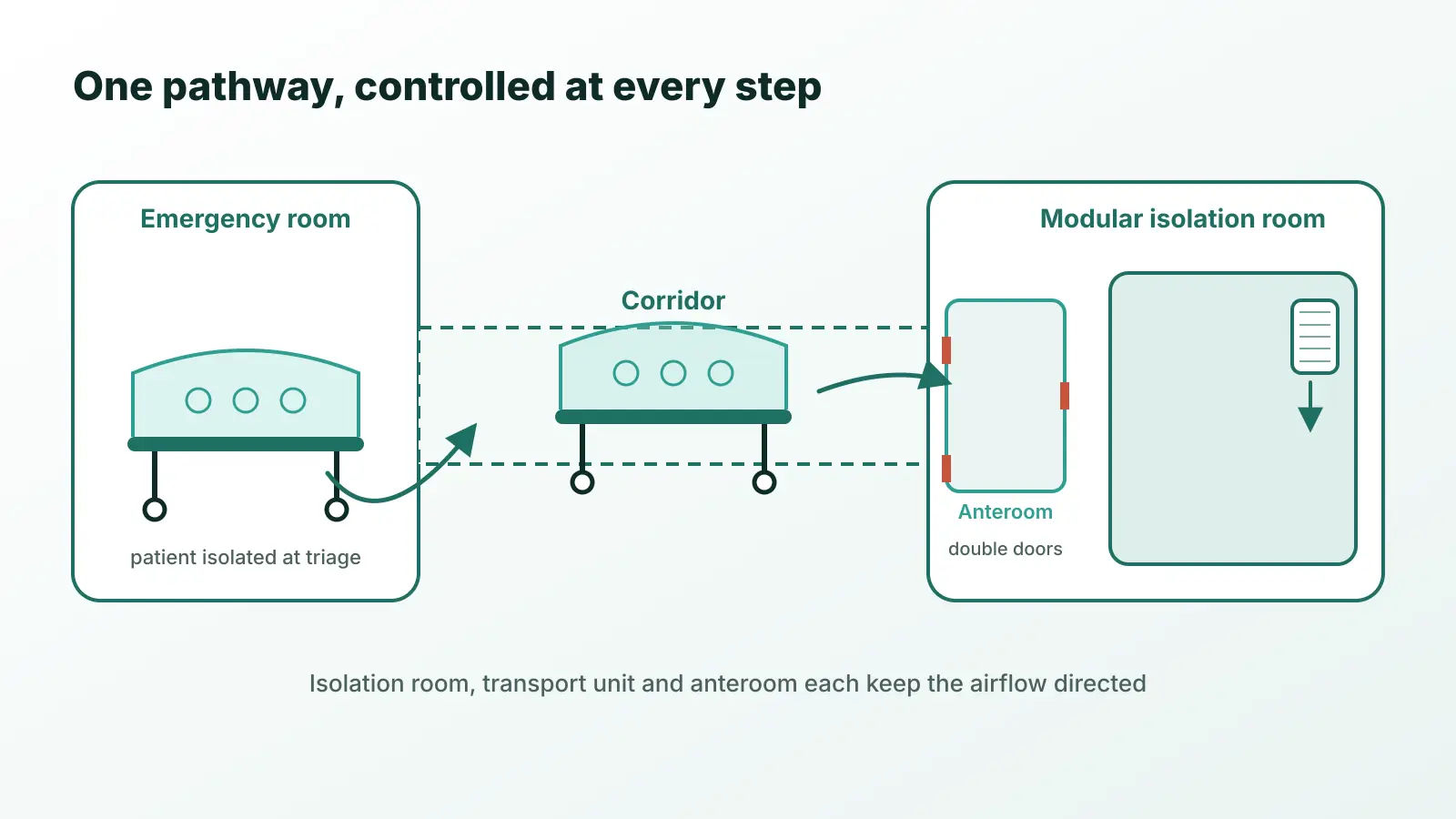
Corridors, lifts and shared spaces are where infectious and vulnerable patients meet other people. Without negative pressure isolation, a patient transferred on an open stretcher exposes everyone along the route, and a vulnerable patient is exposed to them. Transport isolation keeps the controlled environment intact over that pathway, which is why our article on infectious patient transport in hospitals treats it as a step of care in its own right.
Why do anterooms and double doors matter?
An anteroom or double-door configuration keeps the pressure differential stable when staff enter or leave, because only one door is open at a time and the small buffer volume limits the exchange of air.
Every time a single door opens, the pressure between the room and the corridor tends to equalize for a few moments. The movement of the door and of the person passing through also creates turbulence that can carry air across the threshold in the wrong direction. In negative pressure isolation this is the moment when contaminated air is most likely to escape; in positive pressure it is when contaminants are most likely to enter.
In negative pressure isolation, an anteroom works like an airlock. Staff enter the buffer space, close the outer door, and only then open the inner door. The anteroom also gives them a defined place to put on and remove personal protective equipment. Pandora maintains air pressure through its double-door configuration, even when staff enter or exit the chamber.
Adding an antechamber to an existing room
Many hospital rooms were not built with an anteroom. Pithos, the mobile isolation antechamber, attaches to the existing door frame of a hospital room to prevent or minimize the escape of contaminated air when doors are opened and closed. Its filters and air systems provide a constant supply of clean air, and an ultrasonic disinfectant nebulizer inside provides an additional protective barrier in case personnel enter without adequate protective equipment. Pithos can be installed and removed as needed, and it was commissioned on July 21 at the University Multidisciplinary Hospital for Active Treatment of Infectious and Parasitic Diseases "Prof. Ivan Kirov" in Sofia, Bulgaria's national reference center for infectious diseases.
What should hospitals consider when planning pressure isolation?
Hospitals should map where isolated patients actually move, match each step to a suitable isolation method, and plan staff procedures, power, cleaning and stock alongside the equipment itself.
- Patient pathway. Follow a suspected airborne case from arrival to discharge and identify every point where protection is missing: triage, imaging, lifts, transfers between wards.
- Surge capacity. Fixed rooms are limited in number; modular rooms, antechambers and portable units add negative pressure isolation where and when it is needed.
- Mode selection. Define who decides between negative pressure isolation and positive mode, how the selected mode is checked, and how it is communicated at handover.
- Clinical access. Glove ports, utility portals for IV lines and ECG cables, and side openings determine how much care can be given without opening the enclosure.
- Power continuity. Transport units used for negative pressure isolation need a battery that covers the longest realistic transfer, including waiting times.
- Patient size and age. Adult stretchers, pediatric beds and seated transport chairs serve different patients; choose units accordingly.
- Cleaning and maintenance. Materials should be easy to disinfect, and filters must be replaced and disposed of according to the manufacturer's instructions.
- Training. Staff need regular practice with set-up, mode switching, patient loading and decontamination.
Negative pressure isolation complements, and never replaces, standard and transmission-based precautions such as hand hygiene and personal protective equipment. Equipment choices should follow local and national regulations and the facility's infection prevention policy.
How do Incare products implement negative pressure isolation and positive pressure?
Incare isolation units use a blower and filtration system that can run in negative pressure mode to contain an infectious patient or in positive pressure mode to protect an immunocompromised one, across stretchers, beds, a transport chair and rooms.
STR MK3: isolation unit for any stretcher
The STR MK3 stretcher biocontainment unit is a compact, lightweight enclosure placed on top of a hospital stretcher. Its filtration system and air outlet pipe keep the patient environment at negative pressure relative to the outside, and it can switch to positive pressure for severely immunosuppressed patients. The manufacturer states an NBC protection grade U15 with an efficiency of 99.9975%, tested on particles of average size up to 0.3 microns.
It offers a complete side opening, integrated gloves with sleeves, utility portals, battery backup of up to 12 hours and a maximum load of 200 kg. In negative pressure isolation it can act as the primary transport for a patient with a high infectious risk or as secondary transport within a facility.
STR MK 4 and STR MK 5: emergency stretcher
The STR MK 4 emergency stretcher with isolation system is designed for emergency room evacuations and for the treatment of highly contagious biological diseases or airborne infections. It protects patients of most ages, excluding infants and small children, who breathe on their own or through a ventilated system. The motorized STR MK 5 adds a retractable fifth wheel that reduces start-up push force and steering effort by up to 50%.
STR MK7 / STR MK8: isolation hospital bed
The STR MK7 / STR MK8 biocontainment hospital bed supports the transport, diagnosis and assistance of patients with high-risk and airborne contagious diseases within the healthcare facility. In negative pressure isolation the disease cannot escape the isolation cabin while the patient is diagnosed and treated; in positive pressure, patients with an immune deficit are protected. The STR MK8 adds a motorized fifth wheel on a damper device.
STR MK9: pediatric bed
The STR MK9 pediatric biocontainment bed brings negative pressure isolation and positive pressure protection to intensive care units, anesthesia wards and resuscitation areas, with an intuitive control panel at the head end of the bed.
Aura: transport chair
Aura, the biocontainment transport chair, is a small unit suited to any emergency room. A metal frame covered with a resistant transparent polyvinyl chloride sheet, a ventilation system operating at positive or negative pressure and a sealed pocket for passing objects allow seated patients, infectious or immunosuppressed, to be moved safely.
Pandora and Pithos: rooms and antechambers
Pandora switches between negative and positive air pressure with a simple switch and uses NBC filters with protection grade H14 (HEPA), or U15 (ULPA) on request. Pithos adds an antechamber to an existing room. The complete range is presented on the isolation and transport products page.
Frequently asked questions about negative pressure isolation
Is negative pressure isolation the same as an airborne infection isolation room?
An airborne infection isolation room is one application of negative pressure isolation at room scale. The same principle is also applied to modular rooms, hospital beds, stretchers and transport chairs, which create a smaller enclosure around the patient.
Can one unit provide both negative and positive pressure?
Yes. Incare isolation units such as the STR MK3, STR MK 4, STR MK7 / STR MK8, STR MK9, Aura and Pandora can operate in either negative or positive pressure mode, chosen according to the condition of the patient.
Which mode protects healthcare workers?
Negative pressure isolation protects healthcare workers, other patients and the surrounding environment from an infectious patient. Positive pressure mode protects the patient inside the enclosure from the external environment.
Does pressure isolation replace personal protective equipment?
No. Pressure isolation is an engineering control that works together with standard and transmission-based precautions, including hand hygiene and personal protective equipment, as described in WHO and CDC infection prevention guidance.
How long can a portable isolation unit run without mains power?
The STR MK3 has a battery backup of up to 12 hours, according to the manufacturer. For the operating autonomy of other models, request the technical data sheet from Incare.
What happens to the pressure when a door is opened?
Opening a door briefly reduces the pressure differential between a room and the corridor. A double-door configuration, as in Pandora, or an antechamber such as Pithos keeps one door closed at all times and limits the escape of contaminated air.
Plan negative pressure isolation for your facility
Describe your patient pathways and isolation needs, and the Incare team in Sofia will help you choose between transport units, isolation beds, modular rooms and antechambers.