


In a biocontainment unit, the enclosure and the blower create a controlled airflow, but it is the filter that removes the particles. Intelligent Care is part of Stretchers Industries OOD, based in Sofia, Bulgaria, and supplies isolation units for transport, care and rooms to healthcare providers across Europe and beyond.
This guide explains how high-efficiency filters are classified, what separates a HEPA H14 filter from a ULPA filter of class U15, how to read the performance figures stated for Incare isolation units, and where the filter sits when a unit runs in negative or positive pressure. It is a companion to our guide to negative and positive pressure isolation.
What is a ULPA filter?
A ULPA filter, or ultra-low penetration air filter, is a high-efficiency particulate filter in the U group of the European classification, one step above the HEPA H group, and it lets through even fewer particles at the most penetrating particle size.
HEPA stands for high-efficiency particulate air. Both HEPA and ULPA filters are made of a dense mat of very fine fibers, typically glass fibers, folded into deep pleats to give a large surface area within a compact frame. Air passes through the mat at low velocity, and particles are retained on the fibers. The difference between a HEPA and a ULPA filter is not a different principle but a tighter performance requirement: a ULPA filter is allowed a much lower penetration, that is, a smaller fraction of particles passing through.
How does a fibrous filter capture particles?
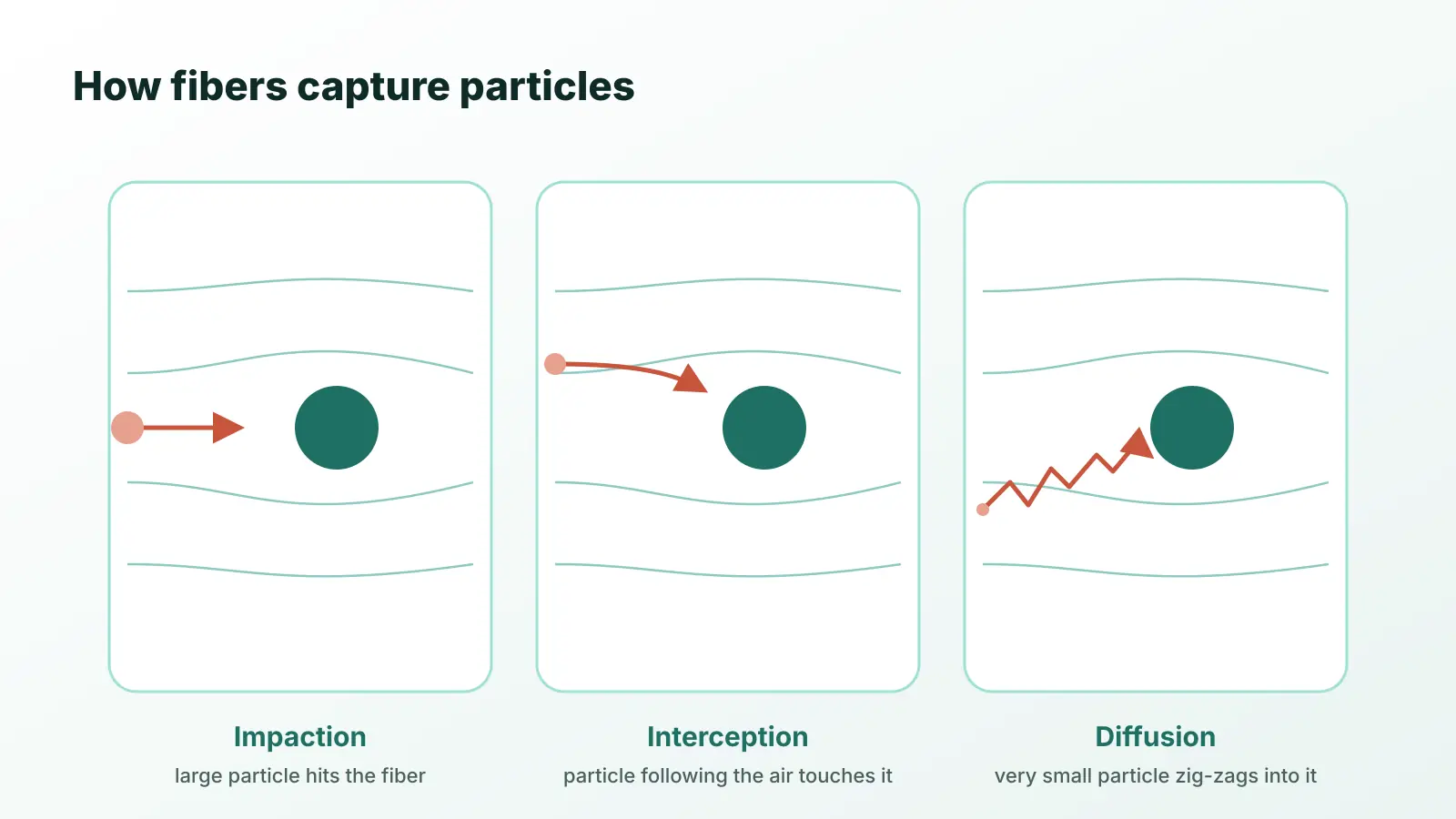
A common misconception is that a filter works like a sieve, stopping only particles larger than its openings. In reality the gaps between fibers are much larger than most of the particles retained. Capture happens through three main mechanisms:
- Impaction. Larger, heavier particles cannot follow the air as it bends around a fiber, so they collide with it and stick.
- Interception. Medium-sized particles follow the airflow but pass close enough to a fiber to touch it and be held.
- Diffusion. The smallest particles move randomly as they are struck by air molecules, which makes them likely to meet a fiber even in slow airflow.
Because impaction and interception work best on larger particles and diffusion works best on the smallest ones, there is an intermediate size at which a filter is least effective. That size is central to how every HEPA and ULPA filter is tested.
How does EN 1822 classify HEPA and ULPA filters?
The European standard EN 1822 sorts high-efficiency filters into three groups, E (EPA), H (HEPA) and U (ULPA), and assigns each filter to a class according to its efficiency measured at the most penetrating particle size.
EN 1822 is published through the European standardization bodies; its first part, which defines the classes, can be looked up in the EN 1822-1 catalogue entry, and the CEN-CENELEC standards portal lists current European standards. The international standard ISO 29463 follows a similar logic, with test methods based on the most penetrating particle size and its own class designations. When comparing products, always check which standard and which class a filter refers to.
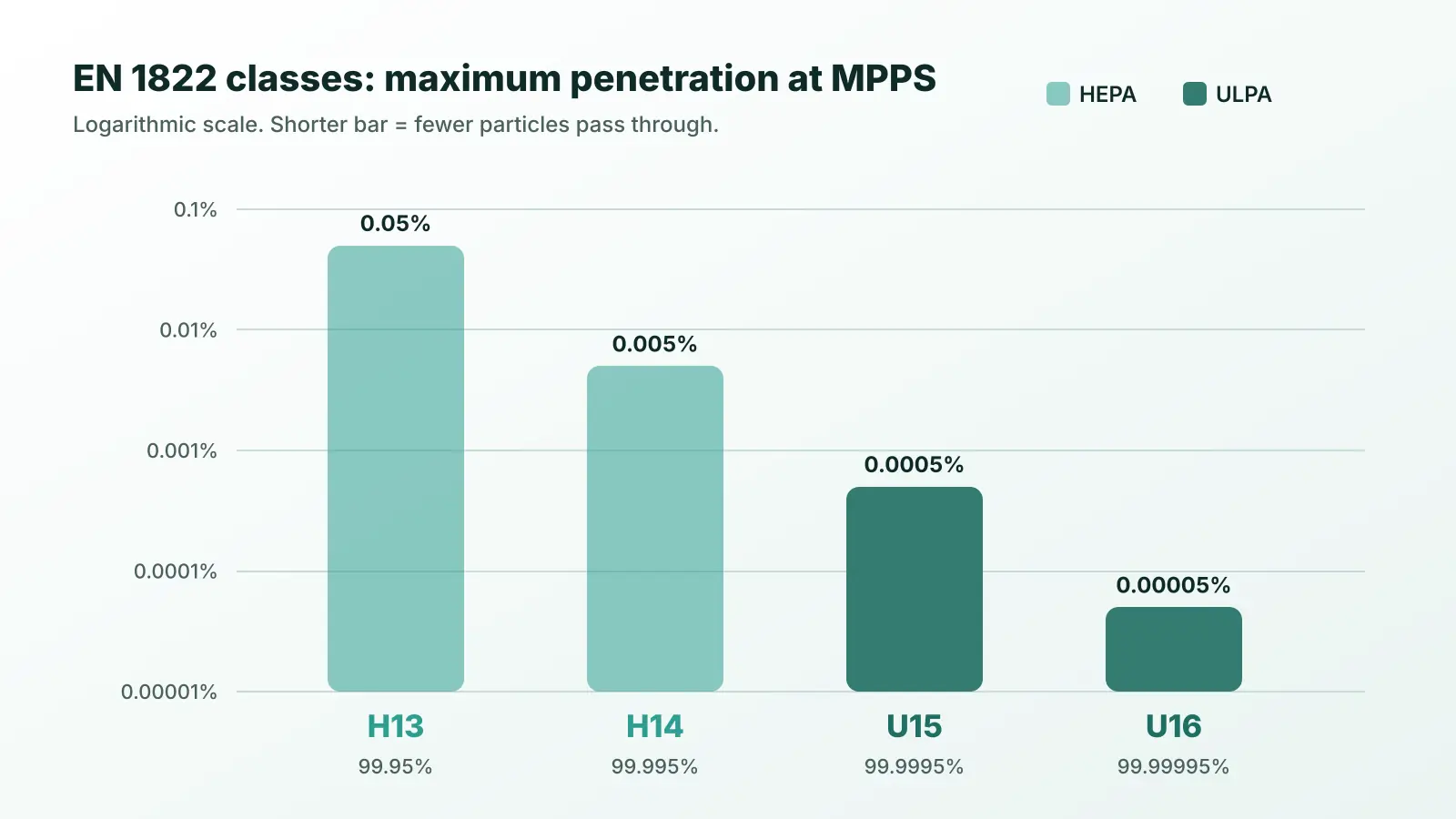
Within each group the class number rises as performance improves. EPA classes cover efficient particulate filters used in many ventilation applications; HEPA classes H13 and H14 are typical of cleanrooms, operating theatres and isolation systems; ULPA classes from U15 upwards are used where the permitted penetration must be lower still. A ULPA filter of class U15 lets through ten times fewer particles at the most penetrating size than an H14 filter.
What is the most penetrating particle size?
The most penetrating particle size, or MPPS, is the particle diameter at which a given filter medium has its lowest efficiency, where the combined effect of impaction, interception and diffusion is weakest. For HEPA and ULPA media it usually lies below 0.3 microns. EN 1822 measures efficiency at this worst-case size, so the class reflects the filter's weakest point rather than its average performance.
What do H14 and U15 require?
EN 1822 tests HEPA and ULPA filters both as a whole, giving the integral efficiency, and by scanning the face of the filter for local leaks. The standard integral thresholds are at least 99.995% for H14 and at least 99.9995% for a U15 ULPA filter.
| Class (EN 1822) | Group | Minimum integral efficiency at MPPS | Maximum integral penetration |
|---|---|---|---|
| H13 | HEPA | 99.95% | 0.05% |
| H14 | HEPA | 99.995% | 0.005% |
| U15 | ULPA | 99.9995% | 0.0005% |
| U16 | ULPA | 99.99995% | 0.00005% |
What does "U15 with 99.9975% efficiency at 0.3 microns" mean on Incare units?
It is the performance stated by the manufacturer for the filtration system of Incare isolation units: an NBC protection grade U15, with an efficiency of 99.9975%, tested to block solid and liquid particles of average size up to 0.3 microns.
The statement has three parts. "U15" places the filter in the ULPA group. "99.9975%" is the efficiency stated by the manufacturer, meaning that under the test conditions described, the share of particles that pass the filter is a small fraction of one per thousand. "Solid and liquid particles of average size up to 0.3 microns" describes the test aerosol: airborne particles include both dry particles and tiny liquid droplets, and 0.3 microns is a size commonly used as a reference in filter testing.
This wording appears on the pages of the STR MK3, STR MK 4, STR MK7 / STR MK8 and STR MK9. It is the figure stated by the manufacturer. For the test method, the standard applied and the full specification of the ULPA filter fitted to a given model, request the technical data sheet from Incare.
When you compare isolation units from different suppliers, ask for the filter class, the standard it refers to, the test particle size and the test method. A ULPA filter or a HEPA filter is only as effective as the seal between the filter and its housing.
What is an NBC filter?
NBC stands for Nuclear, Biological and Chemical; an NBC protection grade indicates a filter assembly intended for protection against these classes of hazard, and in Incare isolation units it is combined with a stated U15 or H14 particulate class.
For infection control the biological part is the relevant one. Bacteria and viruses that travel through the air do so inside or on aerosol particles, such as droplet nuclei or dust. Capturing those particles is the task of the particulate stage, which is why the HEPA or ULPA class matters most when the threat is a pathogen. The WHO infection prevention and control guidance treats this kind of engineering control as one layer of protection among several, alongside hand hygiene and personal protective equipment.
The composition of an NBC filter assembly differs between applications. If your risk assessment includes hazards beyond biological agents, ask Incare which protection is provided by the specific unit you are considering rather than relying on the NBC label alone.
Where is the filter placed in negative and positive pressure mode?
In negative pressure mode the filter cleans the air leaving the enclosure, protecting the outside; in positive pressure mode it cleans the air entering the enclosure, protecting the patient.
Exhaust filtration
The blower draws air out of the enclosure. Before discharge, the air passes through the HEPA or ULPA filter, so pathogens released by an infectious patient are retained.
Supply filtration
The blower pushes outside air into the enclosure through the filter. Air reaching an immunocompromised patient has been cleaned first and then flows outward.
On the STR MK3, for example, the filtration system and its air outlet pipe keep the patient environment at negative pressure relative to the outside, while the same unit can also run in positive pressure for severely immunosuppressed patients. In both cases the ULPA filter sits at the single point where air crosses the boundary in a controlled way.
Why the seal matters as much as the media
A filter only protects if all the air goes through it. Air that bypasses the media through a damaged gasket, a poorly seated frame or a leak in the enclosure is not filtered at all. A sealed envelope, sealed utility portals and a correctly installed ULPA filter work together; a high class on the label does not compensate for a leaking housing.
How should isolation unit filters be maintained?
Filters should be inspected, replaced and disposed of according to the manufacturer's instructions, with particular care for filters used in negative pressure mode, which must be treated as potentially contaminated.
- Follow the documentation. Replacement intervals and procedures for each HEPA or ULPA filter are set by the manufacturer and the technical data sheet, not by a general rule.
- Treat used filters as contaminated. A filter that has served an infectious patient holds the particles it captured; change it with appropriate protective equipment and dispose of it according to the facility's waste procedures.
- Check seals and housing. Inspect gaskets, connections and hoses when the filter is changed, because a leak bypasses even a U15 ULPA filter.
- Watch the airflow. As a filter loads with particles, resistance increases; a drop in airflow is a signal to check the filter.
- Keep spares in stock. A unit that cannot be used for lack of a filter offers no protection during a surge. The STR MK3 is designed to be easy to maintain and stock.
- Record every change. Logging dates and units makes it easier to plan replacements and audit infection control procedures.
How is the ULPA filter used across Incare isolation units?
Incare stretchers and beds use an NBC filtration system stated as protection grade U15, the Pandora room uses H14 HEPA filtration with U15 ULPA available on request, and the Pithos antechamber relies on its own filters and air systems.
STR MK3
The filtration system is the heart of the STR MK3 stretcher biocontainment unit, with an NBC protection grade U15 and an efficiency of 99.9975% as stated by the manufacturer. The compact enclosure fits on top of a hospital stretcher, offers battery backup of up to 12 hours and does not retain humidity.
STR MK 4 and STR MK 5
The STR MK 4 emergency stretcher with isolation system uses the same stated U15 NBC protection grade for emergency room evacuations and highly contagious or airborne infections. Its motorized version, the STR MK 5, reduces push force and steering effort by up to 50%.
STR MK7 / STR MK8
The STR MK7 / STR MK8 biocontainment hospital bed combines a U15 NBC filtration grade with a bed designed for transport, diagnosis and assistance within the facility; the STR MK8 adds a motorized fifth wheel.
STR MK9
The STR MK9 pediatric biocontainment bed applies the same ULPA filter grade to intensive care, anesthesia and resuscitation settings for young patients.
Pandora
Pandora, the modular isolation room, is built with NBC filters of protection grade H14 (HEPA) and U15 (ULPA) on request, tested to block solid and liquid particles of average size up to 0.3 microns. Its blower and filtration system switches between negative and positive pressure, and a double-door configuration maintains air pressure during entry and exit.
Pithos
Pithos, the mobile isolation antechamber, is equipped with filters and air systems that provide a constant supply of clean air and trap potentially harmful particles, preventing them from spreading beyond the isolation unit. For its filter specification, request the technical data sheet.
Aura, the biocontainment transport chair, completes the range with a ventilation system operating at positive or negative pressure. All units are listed on the isolation and transport products page.
Frequently asked questions about the ULPA filter
Is a ULPA filter better than a HEPA filter?
A ULPA filter is allowed a lower penetration than a HEPA filter under EN 1822, so it retains a larger share of particles at the most penetrating particle size. Whether that extra margin is needed depends on the application, which is why Pandora uses H14 HEPA filtration as standard and U15 ULPA filtration on request.
What does H14 mean?
H14 is the highest HEPA class in EN 1822. It requires an integral efficiency of at least 99.995% at the most penetrating particle size.
What does U15 mean?
U15 is the first class of the ULPA group in EN 1822. It requires an integral efficiency of at least 99.9995% at the most penetrating particle size.
Can a ULPA filter capture viruses?
Airborne viruses travel inside or on aerosol particles such as droplet nuclei. A ULPA filter is designed to retain airborne particles across this size range with very high efficiency, provided it is correctly sealed in its housing and used within a controlled airflow.
How often should the filter of an isolation unit be replaced?
Replacement intervals depend on how the unit is used, on the particle load and on the manufacturer's instructions. For Incare units, the applicable maintenance information is given in the technical data sheet and user documentation.
Does the filter change between negative and positive pressure mode?
The filter class does not change with the mode. What changes is the direction of airflow, and therefore whether the filter cleans the air leaving the enclosure, in negative pressure, or the air entering it, in positive pressure.
Need the ULPA filter specification for a unit?
Ask the Incare team in Sofia for the technical data sheet of any isolation unit, including filter class, test conditions and maintenance information.