


Every time a patient with an airborne or highly contagious disease leaves an isolation room, the protection provided by that room stays behind. Corridors, lifts, waiting areas and diagnostic rooms are shared spaces, and a single unprotected transfer can expose dozens of people. Safe infectious patient transport means carrying the isolation with the patient.
This guide is written by Intelligent Care (Incare), part of Stretchers Industries OOD, a manufacturer based in Sofia, Bulgaria, that designs patient isolation units and motorized stretchers for healthcare providers across Europe and beyond. It explains the principles in general terms and shows where Incare systems fit. It does not replace the infection control policy of your facility.
Why are intra-hospital transfers a transmission risk?
Intra-hospital transfers are a transmission risk because they move a contagious patient out of a controlled environment into spaces that were never designed to contain pathogens, and they bring that patient close to staff, visitors and vulnerable patients.
An isolation room works because its air, doors and surfaces are managed. A corridor is the opposite: air moves freely, doors open in sequence, and people pass in both directions. Lifts are small enclosed volumes shared within minutes by many users. Imaging suites and operating theatres receive patients from every department. During infectious patient transport, all of these become possible points of exposure.
Healthcare-associated infections are a recognised public health problem in Europe, and the European Centre for Disease Prevention and Control (ECDC) monitors them as a priority area. Diseases transmitted through the air, such as tuberculosis, measles and COVID-19, are particularly difficult to control during movement, because droplets and aerosols can remain suspended and travel beyond the immediate contact area. The CDC Guideline for Isolation Precautions groups precautions into standard, contact, droplet and airborne categories, and recommends limiting the transport of patients on transmission-based precautions to medically necessary purposes, with barriers that contain the source during the move.
There is also the opposite risk. Immunocompromised patients, such as cancer patients or patients with severe immune deficiency, are exposed to pathogens present in shared spaces when they leave a protected room. A transfer plan has to consider who is being protected from whom.
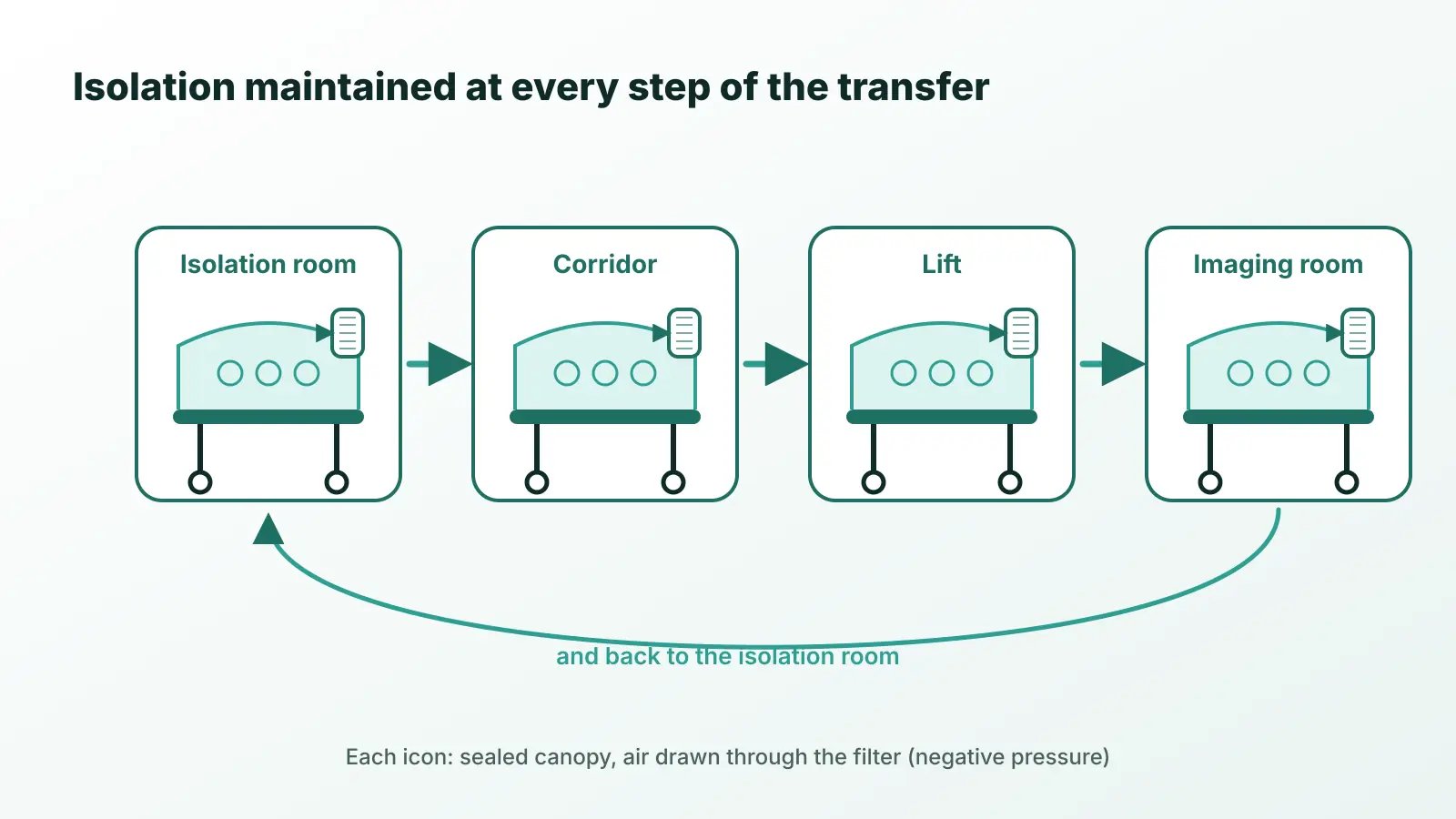
How should the route for infectious patient transport be planned?
Plan the infectious patient transport route before the patient leaves the room: choose the shortest path with the fewest shared spaces, notify the receiving department, clear the route and reserve a lift so the patient never waits in a public area.
Route planning is the simplest measure and one of the most effective. The goal is to reduce the number of people and spaces the patient passes, and the time spent in each one. Points to agree in advance:
- Necessity. Confirm that the procedure cannot be performed at the bedside. Portable diagnostics often avoid a transfer altogether.
- Timing. Schedule the transfer when corridors and waiting areas are quiet, and ask the destination to be ready so the patient goes straight in.
- Path. Prefer service corridors and dedicated lifts. Avoid waiting rooms, cafeterias and outpatient areas.
- Communication. Inform the receiving unit of the type of precautions required, so staff can prepare protective equipment and the room.
- Team. Define who pushes, who opens doors and who manages lines and monitoring. With an isolated patient, nobody should need to improvise.
Physical effort matters too. A stretcher carrying a patient and an isolation unit is heavier than a standard one, and long routes with slopes or thresholds tire the team. Power-assisted versions such as the STR MK 5 and STR MK 8 allow one person to push and steer with less effort; this is covered in our guide to safe patient handling with power-assisted transport.
Which isolation systems support infectious patient transport?
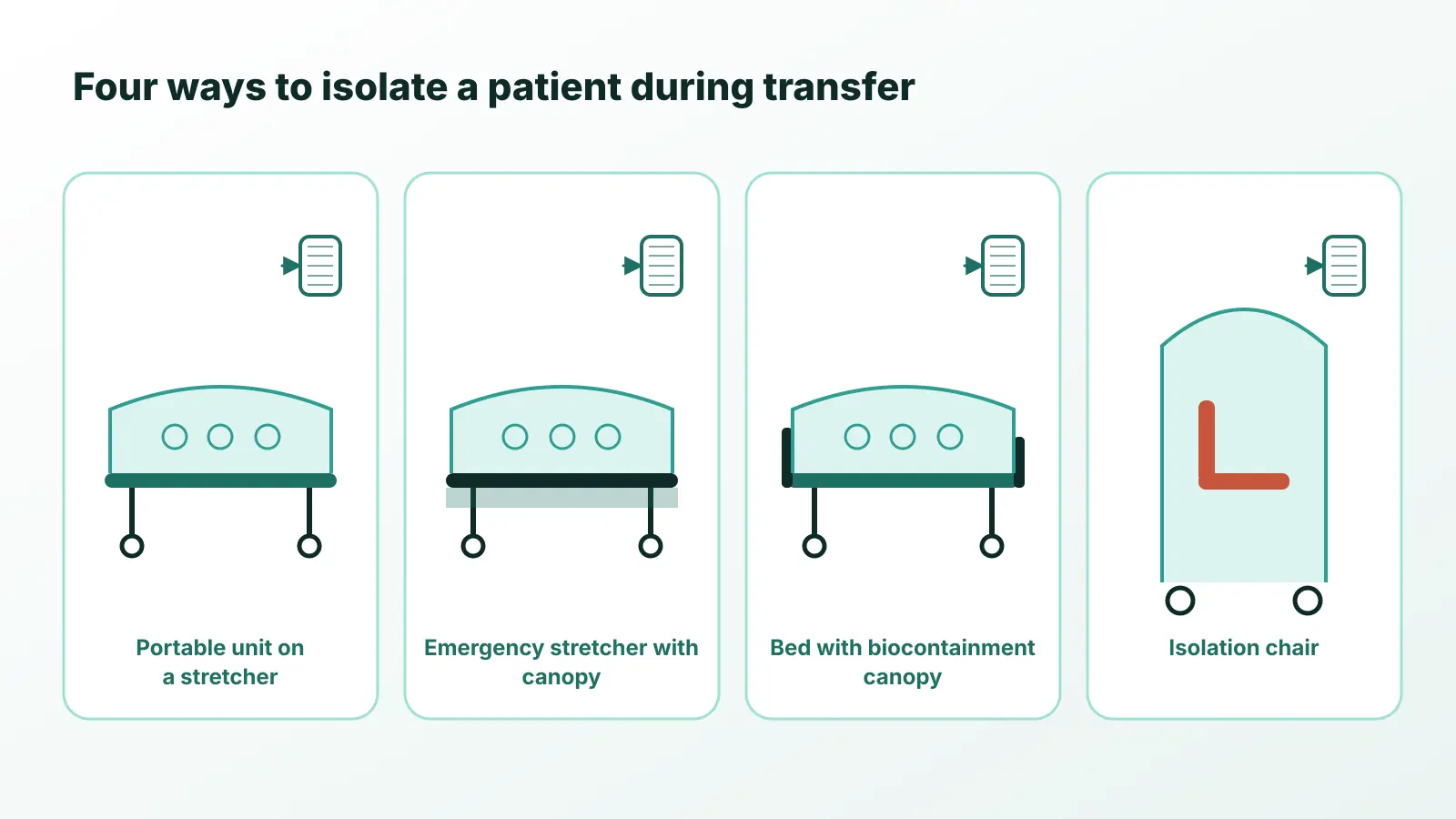
Four types of equipment cover most situations: portable isolation units placed on existing stretchers, emergency stretchers with integrated isolation, hospital beds with a biocontainment canopy, and isolation chairs for patients who can sit.
All Incare isolation units for transfers share the same principle: the patient is enclosed in a sealed transparent envelope, and a filtration system controls the pressure inside it. The filtration has an NBC (Nuclear, Biological and Chemical) protection grade U15 with an efficiency of 99.9975%, tested to block solid and liquid particles of average size up to 0.3 microns. For a deeper look at filter classes, see our guide to HEPA and ULPA filters in isolation units.
Portable isolation unit on a stretcher: STR MK3
The STR MK3 stretcher biocontainment unit is a compact, lightweight envelope placed on top of a hospital stretcher. It is ready to use, has a complete side opening for patient access, integrated gloves with sleeves and utility portals for IV lines and ECG cables. Its measurements are compliant with any type of stretcher or hospital bed, maximum load is 200 kg and the battery backup lasts up to 12 hours. It can act as primary transport for a patient with a high infectious risk, or as secondary transport within a facility. It does not retain humidity and is easy to maintain and stock, which suits hospitals that need to keep units ready.
Emergency stretcher with integrated isolation: STR MK 4 and STR MK 5
The STR MK 4 emergency stretcher with isolation system combines stretcher and isolation cabin in one device, for emergency room evacuations and for the treatment of highly contagious biological diseases or airborne infections. It protects patients of most any age, excluding infants and small children, who are breathing on their own or through a ventilated system. The STR MK 5 is its motorized version, with a retractable fifth wheel that lets one person push and steer.
Isolation beds: STR MK7, STR MK8 and STR MK9
When the patient will stay in the device for diagnosis and care, a bed is more appropriate than a stretcher. The STR MK7 biocontainment hospital bed is a care unit for the transport, diagnosis and assistance of patients with high-risk airborne diseases within the healthcare facility; the STR MK8 adds a motorized fifth wheel. For children, the STR MK9 pediatric biocontainment bed is an electric bed with a control panel at the head end, intended for intensive care, anesthesia and resuscitation areas.
Isolation chair: Aura
Not every patient needs to lie down. The Aura biocontainment transport chair is a controlled pressure chair with a metal frame and a highly resistant transparent PVC cover, designed for the emergency room and for any infectious patient transport where the patient can sit. It works at positive or negative pressure, has a sealed pocket to pass objects, and can be equipped with an IV pole holder, oxygen cylinder holder, glove windows and a tracking system for localization.
Protecting the room door: Pithos
Infectious patient transport starts and ends at a door. The Pithos mobile isolation antechamber attaches to the existing door frame of a hospital room and minimizes the escape of contaminated air when doors are opened and closed. Inside, an ultrasonic disinfectant nebulizer adds a barrier in case of unintentional entry of personnel without adequate protective equipment. For a whole room, Incare also offers the Pandora modular isolation room.
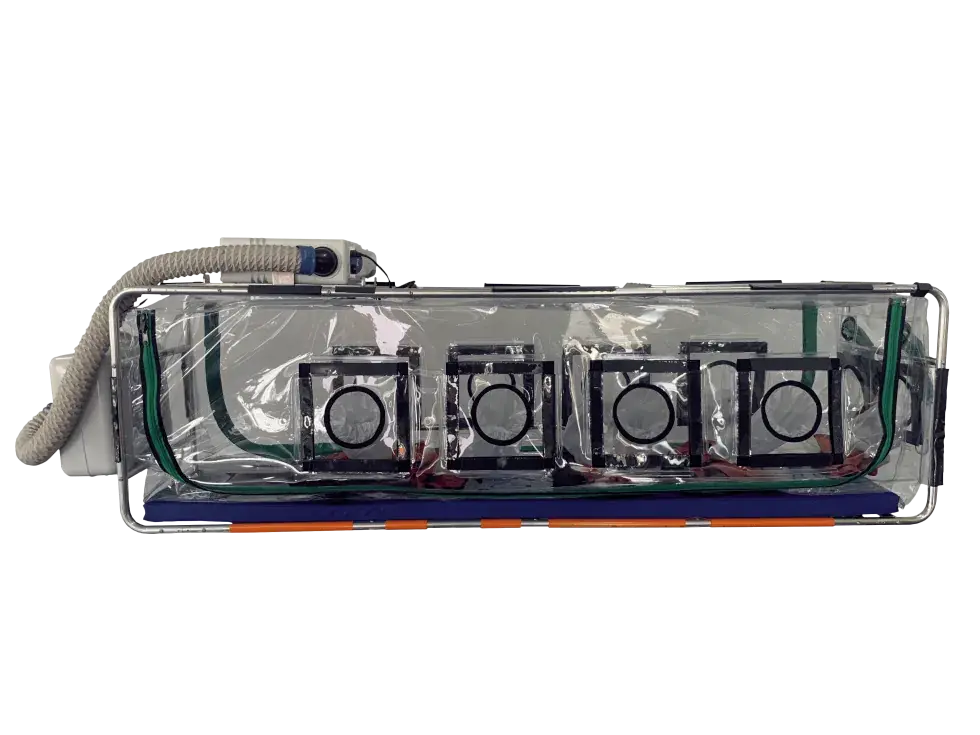 STR MK3Portable isolation unit for any hospital stretcher.View product
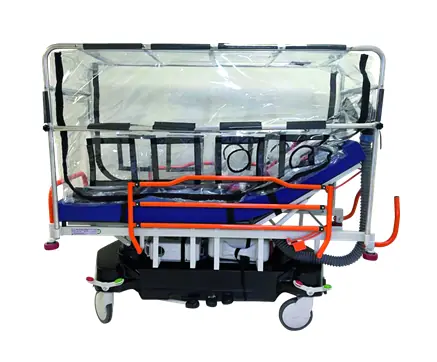 STR MK 4 / MK 5Emergency stretcher with integrated isolation, optional motorized wheel.View product
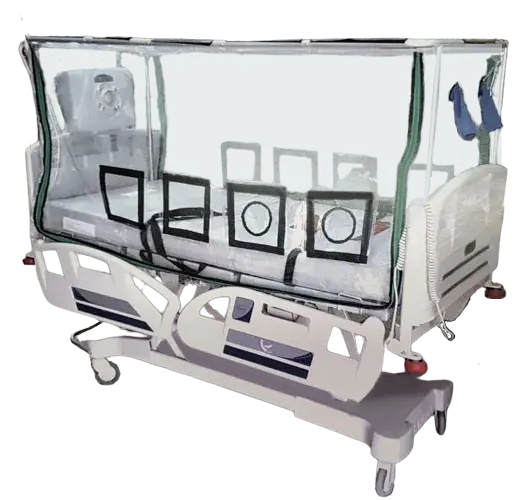 STR MK7 / MK8Biocontainment hospital bed, motorized version available.View product
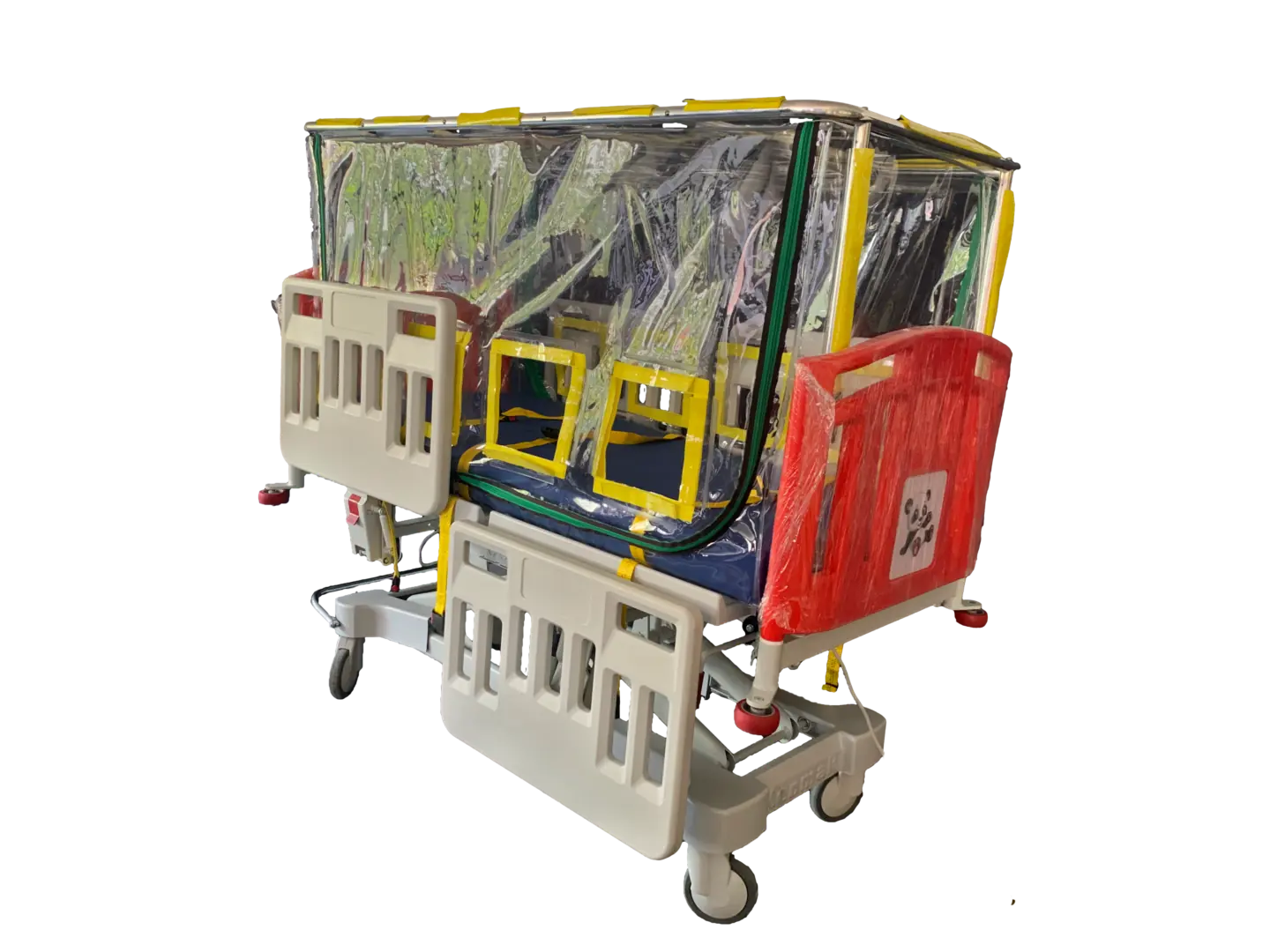 STR MK9Electric pediatric bed with biocontainment system.View product
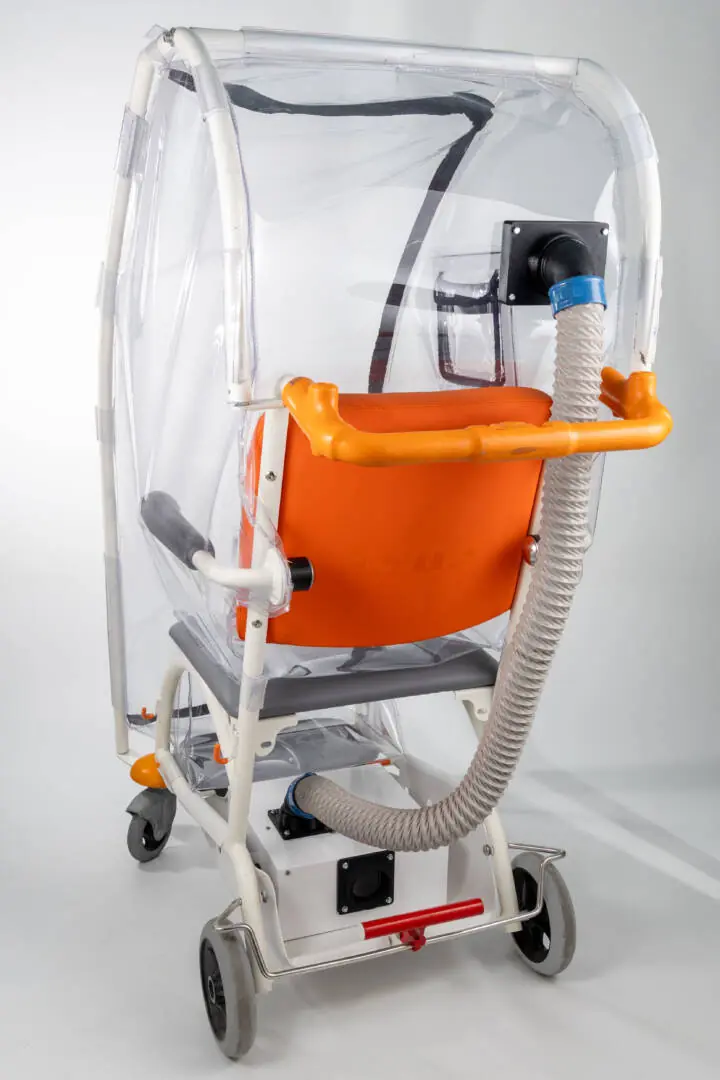 AuraControlled pressure chair for seated patients.View product
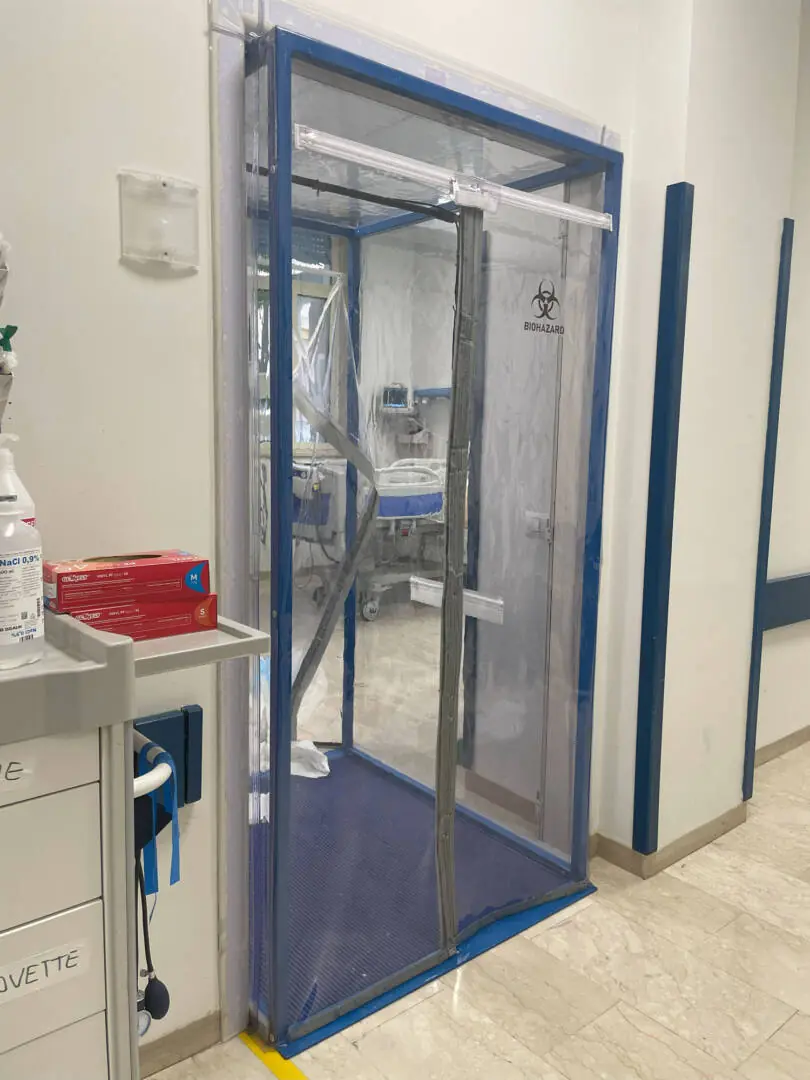 PithosMobile antechamber attached to the room door frame.View product
Negative or positive pressure: which does the patient need?
Use negative pressure when the patient is the source of infection, so air flows into the unit and leaves only through the filter; use positive pressure when the patient is immunocompromised, so filtered air flows out and keeps contaminants away.
Protects the environment
The pressure inside the envelope is lower than outside. Air is continuously drawn through the filter, so contaminated air cannot escape from the unit while the patient is moved, diagnosed or treated. This is the mode for infectious patient transport.
Protects the patient
The pressure inside is higher than outside. Filtered air is pushed outward, preventing external agents from entering. It is used for patients with a deficit of the immune system who are at risk of contracting infections during the transfer.
STR MK3, STR MK 4, STR MK7/MK8, STR MK9 and Aura can all work in both modes, so one device serves both infectious patient transport and the protection of immunocompromised patients. The choice must be made before the transfer, based on the patient's condition. Our negative and positive pressure isolation guide explains the physics and the clinical criteria in more detail.
How are staff protected during infectious patient transport?
Staff are protected during infectious patient transport by two layers: the isolation unit, which contains the source, and personal protective equipment chosen according to the transmission route of the disease.
A sealed envelope changes the situation for the team. Without it, everyone close to the patient is potentially exposed for the entire route. With it, the main barrier travels with the patient, and integrated gloves with sleeves allow staff to reach the patient, adjust lines or reposition a limb without opening the unit. Utility portals let IV lines, oxygen and monitoring cables pass through while the envelope stays sealed.
Personal protective equipment remains necessary. Gloves, gowns, masks or respirators and eye protection are selected according to the precautions in force, as described in the CDC guideline and in your local policy. Staff should put protective equipment on before entering the room, and remove it in the designated area after the transfer, following the facility procedure for doffing and hand hygiene.
Ergonomics is part of staff protection. A team that is not fighting the weight of the stretcher can keep attention on the patient and on the route. On the STR MK 5 and STR MK 8, operating handles with electric brake and directional control, plus a speed limit switch, help the operator control the movement with one hand.
Infectious patient transport checklist
A checklist for infectious patient transport turns principles into steps that every team member can follow in the same order.
- Confirm the need. Verify that the procedure requires a transfer and identify the type of precautions: airborne, droplet or contact, or protection of an immunocompromised patient.
- Choose the device and mode. Select stretcher unit, emergency stretcher, bed or chair, and set negative pressure for an infectious patient or positive pressure for an immunocompromised one.
- Check the equipment. Verify battery charge, filter and seals, and prepare portals for IV lines, oxygen and monitoring.
- Plan and clear the route. Notify the receiving department, reserve the lift and ask that the path be kept free.
- Prepare the team. Assign roles and put on the personal protective equipment required by the policy.
- Place and seal. Position the patient through the side opening, close the envelope and verify that the pressure mode is active before leaving the room.
- Move without stops. Follow the planned route, avoid waiting in shared areas and use the integrated gloves for any intervention.
- Hand over and clean. Transfer the patient at destination, then clean and disinfect the device and remove protective equipment in the designated area.
What happens at the end of infectious patient transport?
At the end of infectious patient transport the patient is handed over in a prepared room, and the device, the route and the team are then returned to a safe state according to the facility cleaning and disinfection procedure.
The receiving room should be ready before the patient arrives, so the unit is opened only where the precautions continue. If the destination is an isolation room, an antechamber such as Pithos at the door limits the escape of air during entry. After the handover, surfaces of the isolation unit, stretcher frame and handles are cleaned and disinfected with products and methods approved by the facility. Filters are managed according to the manufacturer instructions and the local waste policy.
Debriefing is worth a few minutes. Delays at a lift, a door that would not stay open or a missing cable portal are details that improve the next infectious patient transport. Many hospitals record transfers of isolated patients so that routes and equipment can be reviewed over time.
How does infectious patient transport work in the emergency room and triage?
In the emergency room the infection status is often unknown, so isolation must be fast to deploy and simple to use; portable units and isolation chairs allow staff to contain a suspected case from the first minutes.
A patient with symptoms of an airborne disease may arrive without warning and need diagnosis, imaging and admission within hours. Each of these steps is a transfer. The Aura chair was designed specifically for the emergency room, and the STR MK 4 for emergency room evacuations and highly contagious diseases. Thanks to its compact size, the STR MK3 can be deployed quickly where a stretcher is available.
The same approach applies outside the hospital. During contagious emergencies, Incare isolation units can be used to create temporary triage zones in places such as schools, airports and gyms, containing suspected cases until they can be moved. In these settings infectious patient transport often begins far from any isolation room, and the unit is the only controlled environment available.
Comparing Incare systems for infectious patient transport
The right system for infectious patient transport depends on the patient's position, age and length of stay in the device, and on how far the patient has to travel.
| System | Type | Typical use | Pressure modes | Motorized option |
|---|---|---|---|---|
| STR MK3 | Isolation unit for existing stretchers and beds | Primary or secondary transport within a facility, rapid deployment | Negative and positive | No (fits existing stretcher) |
| STR MK 4 / STR MK 5 | Emergency stretcher with integrated isolation | Emergency room evacuations, highly contagious diseases; not for infants and small children | Negative and positive | STR MK 5 |
| STR MK7 / STR MK8 | Hospital bed with biocontainment system | Transport, diagnosis and assistance within the facility | Negative and positive | STR MK8 |
| STR MK9 | Electric pediatric bed with biocontainment system | Pediatric intensive care, anesthesia, resuscitation | Negative and positive | Not stated |
| Aura | Biocontainment transport chair | Emergency room, seated patients | Negative and positive | Not stated |
| Pithos | Mobile antechamber on the room door frame | Start and end point of the transfer, room entry | Filtered air system | Not applicable |
For a hospital that already owns stretchers, the STR MK3 is the most flexible starting point. Departments that receive suspected cases daily may prefer a dedicated emergency stretcher or chair. Units that keep patients isolated for diagnosis and care benefit from a bed, and pediatric departments from the STR MK9. All Incare systems are presented in the isolation units range and in the product catalogues.
Frequently asked questions about infectious patient transport
What is infectious patient transport?
Infectious patient transport is the movement of a patient with a known or suspected transmissible infection from one place to another, for example from a ward to imaging or from the emergency room to an isolation room, while preventing pathogens from reaching staff, other patients and the environment along the way.
Can a standard hospital stretcher be used to move an infectious patient?
Yes, if it is fitted with a portable isolation unit. The STR MK3 is designed to be placed on top of a hospital stretcher; its measurements are compliant with any type of stretcher or hospital bed, and it keeps the patient environment at negative pressure through a U15 filtration system.
When is positive pressure used during a transfer?
Positive pressure is used when the patient is the one who must be protected, for example a severely immunosuppressed patient. Filtered air keeps the inside of the unit at a higher pressure than the surrounding area, so external contaminants are pushed away from the patient.
How long can a portable isolation unit operate away from a power socket?
For the STR MK3 the manufacturer states a battery backup of up to 12 hours. Transfer times within a hospital are normally much shorter, but the backup also covers waiting times at imaging or in a corridor.
Is there a solution for children?
Yes. The STR MK 4 is suitable for patients of most ages but excludes infants and small children. For paediatric care Incare offers the STR MK9, an electric pediatric bed with a biocontainment system for intensive care, anesthesia and resuscitation areas.
Which guidelines should a hospital follow?
Transfers should follow the facility infection control policy, which is typically based on national rules and on references such as the CDC Guideline for Isolation Precautions and ECDC guidance on healthcare-associated infections. Isolation equipment supports these procedures but does not replace them.
Plan safer transfers with Incare
Tell us how patients move in your facility and we will help you choose isolation units for infectious patient transport on each route, from the emergency room to the ward.